Gynecomastia in Dnipro
Gynecomastia is an enlargement of the breasts in men caused by growth of glandular tissue. It can affect one or both sides of the chest and may be accompanied by nipple sensitivity, tenderness, or a noticeable change in chest contour.
What Is Gynecomastia?
Gynecomastia is a benign enlargement of the glandular breast tissue in men. A small amount of glandular tissue is normally present in the male breast as well. Under the influence of hormonal changes or other factors, its volume can increase. Gynecomastia can occur at different stages of life, including in adolescents and adult men. In some patients the changes resolve on their own; in others they persist for a long time. An enlarged male chest is not always due to gynecomastia. The cause may be excess fatty tissue, hormonal changes, certain medications, or particular medical conditions. That is why the cause of the changes must be established before choosing a treatment.
GENEVITY — the Centre for Longevity and Quality of Life in Dnipro — approaches men's health and aesthetic correction as part of a comprehensive view of a person's physical condition, appearance, and everyday comfort.
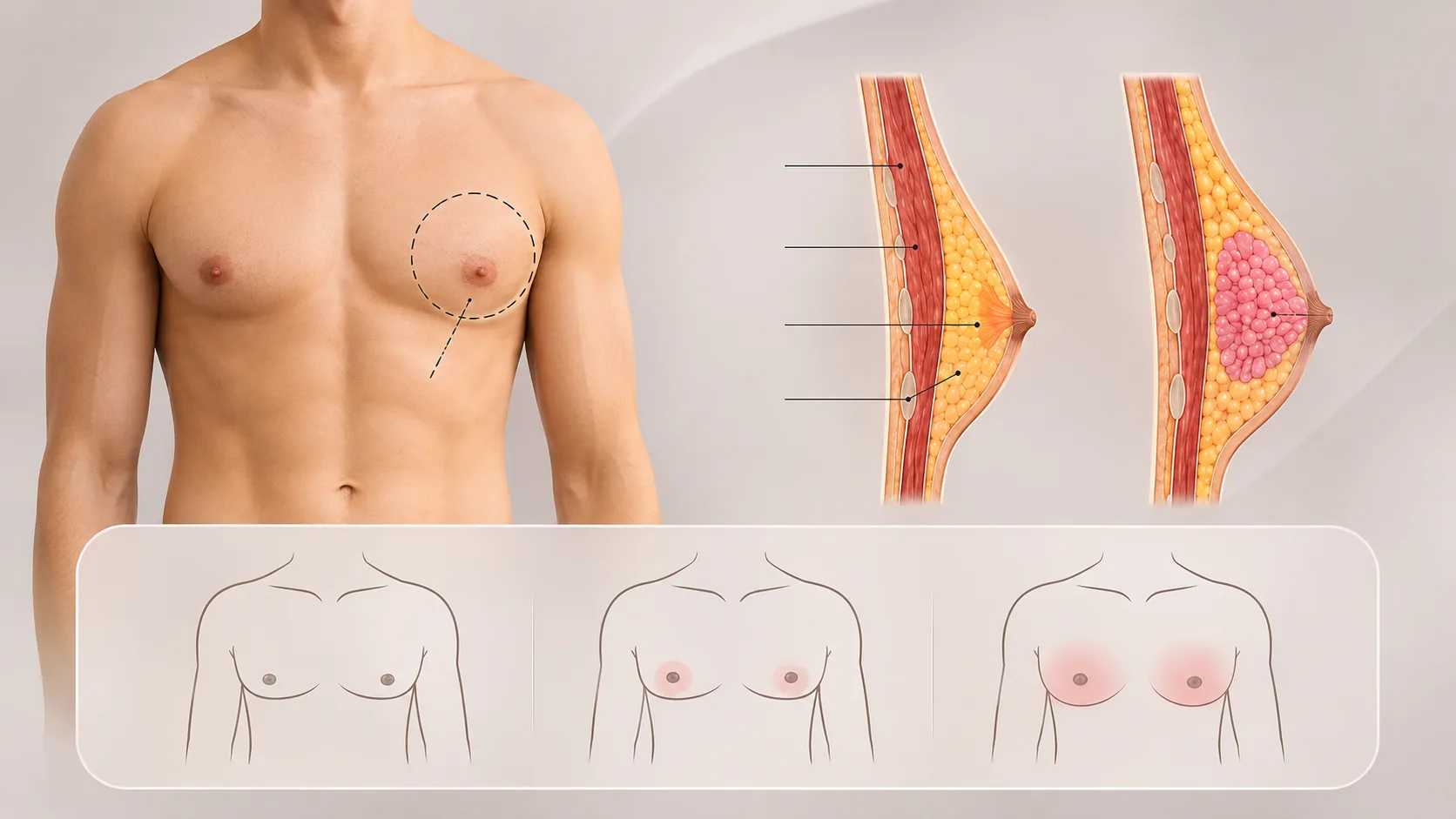
Typical Signs
enlargement of one or both breasts;
swelling around the nipples;
a palpable firm area beneath the areola;
increased breast sensitivity;
tenderness or discomfort to the touch;
a change in the usual contour of the chest.
However, not every enlargement of the male chest is true gynecomastia. To choose the right treatment, it is important to distinguish growth of glandular tissue from an accumulation of subcutaneous fat.
Types of Gynecomastia in Men
In clinical practice it is important to distinguish between several conditions that can look similar. True gynecomastia involves an increase in glandular tissue. On examination, the doctor may find a firm or rubbery mass beneath the nipple and areola. When true gynecomastia has been present for a long time, dietary changes and exercise usually cannot fully eliminate the enlarged glandular tissue.
False Gynecomastia
False gynecomastia, or lipomastia, is an enlargement of the male chest caused mainly by fatty tissue. It is often associated with general excess body weight, but can also occur because of an individual pattern of fat distribution. With lipomastia, weight loss can sometimes reduce the volume of the chest. If localised fat deposits persist, liposuction may be considered in certain cases.
Mixed Gynecomastia
In the mixed form, chest enlargement involves both glandular and fatty tissue. In such cases surgical correction may include removal of the glandular component together with liposuction.
The changes may affect one breast or both. With one-sided enlargement — especially if it appeared recently, is progressing quickly, or is accompanied by a firm lump — other conditions must be ruled out.
What Causes Gynecomastia?
The causes of male breast enlargement vary. The condition is often linked to a shift in the balance between the effects of androgens and oestrogens on breast tissue. Gynecomastia can develop during puberty, and in adult men with age-related hormonal changes. In adolescents, breast enlargement is often temporary and may resolve on its own. Obesity can be accompanied by increased fatty tissue in the chest and changes in hormone metabolism. Some patients have true gynecomastia and lipomastia at the same time. Breast enlargement may be associated with certain medications, including some hormonal drugs and treatments for chronic conditions. Never stop prescribed medication on your own. Any change to treatment should be discussed with the doctor who prescribed it. Anabolic steroid use can disrupt hormonal balance and contribute to the development of gynecomastia. Male breast enlargement is sometimes associated with hypogonadism, thyroid dysfunction, liver or kidney disease, or tumours that affect hormone metabolism. In some cases a specific cause cannot be identified.
The key principle of treatment is to identify the cause of gynecomastia first, and only then to choose a correction method.
How Can a Man Tell If He Has Gynecomastia?
The appearance of the chest does not always make it possible to determine the nature of the changes accurately. With true gynecomastia, glandular tissue may be felt beneath the areola. With lipomastia, the enlargement is more often due to a more even distribution of fat. However, it is difficult to reliably tell these conditions apart on your own. Where necessary, laboratory tests and breast imaging are ordered.
For Diagnosis, the Doctor Assesses
how long the breast enlargement has been present;
whether there is tenderness;
whether the changes are one-sided or on both sides;
body weight and any fluctuations in it;
medications and other substances being taken;
features of sexual development;
symptoms of possible endocrine disorders;
the results of the examination and additional investigations.
When Should You See a Doctor?
Any new or unexplained enlargement of the male breast warrants medical assessment.
It Is Especially Important Not to Delay If You Notice
a rapidly growing lump in the breast;
a firm nodule that is not located directly beneath the nipple;
nipple discharge, especially if bloody;
nipple retraction;
skin changes, sores, or marked hardening;
enlarged lymph nodes in the armpit;
persistent one-sided pain or swelling.
These signs do not necessarily mean a malignant condition, but they do require investigation. An aesthetic operation must never be planned in place of investigating a suspicious breast lump.
Gynecomastia Diagnosis in Dnipro
Breast Examination
The doctor assesses volume, symmetry, tissue consistency, and the condition of the nipples and areolas. This helps to make a preliminary distinction between true gynecomastia and a predominant build-up of fatty tissue.
Breast Ultrasound
Ultrasound may be used to assess tissue structure and clarify the nature of the changes. If a malignant process is suspected, the doctor may order mammography and, where indicated, a biopsy.
Hormone Tests
Depending on the examination findings, testosterone, oestradiol, LH, FSH, TSH, prolactin and other markers may be measured. The scope of testing is determined individually.
Further Investigations
If a condition related to a hormonal disturbance is suspected, liver and kidney function tests, a testicular examination, and other investigations may be needed.
Diagnosis begins with a doctor's consultation, a medical history, and a physical examination. Depending on the clinical situation, consultations with an endocrinologist, a breast specialist, a surgeon, or other specialists may be needed. Once the cause is established, the doctor determines whether treatment of an underlying condition, observation, or surgical correction is needed.
Can Gynecomastia Be Treated Without Surgery?
Not every patient with gynecomastia needs surgery. The choice of treatment depends on the cause, how long the condition has been present, the severity of symptoms, and the nature of the tissue. In adolescence, gynecomastia often regresses on its own. If examination finds no serious cause, the doctor may recommend observation. If the breast enlargement is linked to an endocrine or other condition, the identified cause needs to be treated. If a medication is suspected, the doctor may consider replacing it or changing the treatment regimen. With lipomastia, reducing overall body fat can improve the contour of the chest. However, weight loss does not always eliminate true gynecomastia. In certain clinical situations a specialist may consider drug therapy.
Hormonal and anti-oestrogen drugs are not, however, a universal treatment for gynecomastia and must never be self-prescribed.
Gynecomastia Removal in Men
If the glandular tissue has been enlarged for a long time and the changes persist after possible causes have been addressed, surgery may be considered. Surgical treatment of gynecomastia aims to reduce breast volume and correct the contour of the male chest. The operation may involve removal of glandular tissue, liposuction, or a combination of the two. Where there is significant excess skin, an additional lift is sometimes required.
Removal of Glandular Tissue
In true gynecomastia, the surgeon removes the excess glandular tissue through a planned incision. One common approach places the incision along the edge of the areola, although the specific technique depends on the anatomy. The aim of the operation is to reduce tissue volume and create a smoother chest contour while preserving the blood supply and sensation of the nipple-areola complex as far as possible.
Liposuction for Gynecomastia
Liposuction is used to remove excess fatty tissue. When chest enlargement is mainly due to fat, it can be used as a stand-alone method. Where there is a significant glandular component, liposuction alone is often not enough.
Combined Correction
In mixed gynecomastia, the surgeon may combine removal of glandular tissue with liposuction. This approach makes it possible to address the different components of the chest enlargement.
Removal of Excess Skin
With significant breast enlargement or after major weight loss, the skin may lose its elasticity. In some cases the excess skin must be removed and the position of the areola corrected. Such procedures may leave longer scars.
Who Is Gynecomastia Surgery Suitable For?
- the necessary diagnostic work-up has been completed;
- conditions requiring other treatment have been ruled out;
- possible causes of the breast enlargement have been eliminated or stabilised;
- the changes have persisted for a long time;
- there is physical or marked aesthetic discomfort;
- the patient understands the limitations and risks of the operation;
- the patient's general health allows the procedure to be performed.
Contraindications to Surgery
- acute infectious diseases;
- decompensated chronic conditions;
- blood clotting disorders;
- active conditions that require treatment first;
- a suspicious breast lump whose cause has not been established;
- a high risk of anaesthetic complications;
- other individual medical restrictions.
The decision on whether surgery is possible is made after an examination. If there is an active hormonal disorder, appropriate treatment may be needed first. In adolescents, surgery is considered with particular caution, taking into account the stage of development and the likelihood that the breast enlargement will resolve on its own.
How Is Gynecomastia Surgery Performed?
Consultation and Planning
The plastic surgeon assesses the volume of glandular and fatty tissue, skin elasticity, chest symmetry, and the position of the areolas. Possible correction methods, future scars, and the expected result are discussed.
Preoperative Preparation
Before surgery, investigations are carried out and anaesthetic risks are assessed. If needed, the patient first sees an endocrinologist or other specialists.
Anaesthesia
Depending on the extent of the procedure, different types of anaesthesia may be used. The appropriate method is chosen by the surgeon and the anaesthetist.
Surgical Correction
The surgeon removes the planned volume of glandular and/or fatty tissue. Excess skin is corrected where necessary.
Postoperative Monitoring
After the procedure, the condition of the tissues, any bleeding, swelling, and the patient's general well-being are monitored. In some cases temporary drains are placed. Whether a hospital stay is needed depends on the complexity of the operation and the patient's condition.
Recovery After Gynecomastia Surgery
After surgical correction, swelling, bruising, tenderness, and temporarily reduced skin sensation over the chest are possible. The length of recovery depends on the extent of the operation. In the first weeks it is important to limit strain on the chest muscles and avoid movements that stretch the healing tissues.
Key Recommendations After Surgery
follow the surgeon's instructions;
wear compression garments if recommended;
care for the surgical wounds properly;
temporarily avoid lifting heavy objects;
avoid intense chest workouts;
return to physical activity gradually;
do not take any medication without your doctor's approval;
attend follow-up appointments.
How Long Does Recovery Take?
After a relatively minor procedure, a return to light work may be possible within a few days or one to two weeks. After more extensive surgery, recovery takes longer. Strenuous activity is often restricted for several weeks. A full return to training is decided by the surgeon. The final contour of the chest is usually assessed after several months, once swelling has subsided and the tissues have settled.
Do Scars Remain After Gynecomastia Surgery?
Any surgery involving incisions leaves scars. When glandular tissue is removed, the incision can be placed along the edge of the areola, which sometimes makes the scar less noticeable. Liposuction leaves small marks at the access points. With significant excess skin, longer incisions may be needed. Over time scars usually become less pronounced, but they do not disappear completely. Their appearance depends on individual healing and postoperative care.
Results of Gynecomastia Surgery
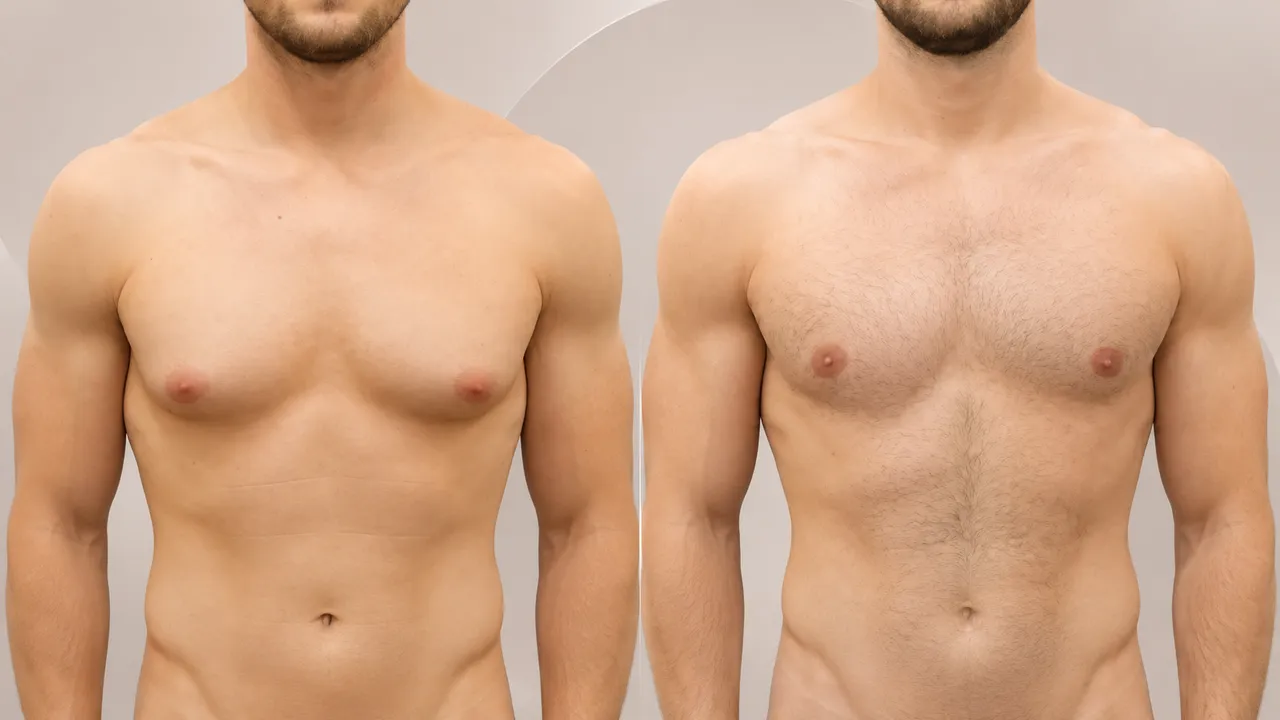
Surgical correction can reduce the volume of the male chest and make the chest contour flatter. The result, however, depends on the initial anatomy, the amount of tissue removed, and the condition of the skin.
Possible Changes
reduced chest projection;
correction of the contour beneath the areola;
reduced asymmetry;
removal of excess glandular tissue;
improved chest proportions.
Perfect symmetry and the absence of visible scars cannot be guaranteed. The result can last a long time, but the chest may enlarge again if hormonal disturbances persist, certain medications are used, or body weight changes significantly.
Possible Risks and Complications
bleeding and haematoma;
infection;
fluid accumulation (seroma);
impaired healing;
chest asymmetry;
contour irregularities;
excessive or insufficient tissue removal;
changes in nipple sensation;
noticeable scarring;
tissue damage or impaired blood supply;
thromboembolic complications;
the need for a further operation.
Gynecomastia removal is a full surgical procedure. Before surgery, the doctor must explain the individual risks and obtain the patient's informed consent.
Gynecomastia and Exercise
Physical activity helps maintain a healthy body weight and develop the chest muscles. However, training cannot eliminate enlarged glandular tissue in true gynecomastia. If the chest enlargement is mainly due to fat deposits, losing weight may reduce its volume. In the mixed form, the changes after weight loss may be only partial. The choice between exercise, observation, drug treatment, and surgery therefore depends on the cause of the enlargement.
Gynecomastia and Men's Quality of Life
Breast enlargement can bring not only physical discomfort but also concerns about appearance. Some men feel self-conscious when choosing clothes, playing sports, or going to the swimming pool. Gynecomastia is a medical condition, not a sign of poor fitness or personal neglect. When discussing surgical treatment, it is important to consider not only the appearance of the chest but also the causes of the changes, general health, the patient's expectations, and the possible risks.
GENEVITY — the Centre for Longevity and Quality of Life — views men's health in the context of physical condition, psychological well-being, and individual needs.
How Much Does Gynecomastia Removal Cost in Dnipro?
The price of gynecomastia surgery in Dnipro depends on the type of chest enlargement, the extent of the procedure, and the surgical technique chosen.
Factors That May Affect the Cost
whether the enlargement is true, false, or mixed;
one-sided or bilateral correction;
the need to remove glandular tissue;
the use of liposuction;
the need to remove excess skin;
the type of anaesthesia;
preoperative investigations;
hospital stay and postoperative monitoring.
The exact cost is determined after diagnosis and an individual treatment plan. If you have noticed breast enlargement, a change in chest shape, or discomfort around the nipples, your first step should be a medical consultation. It is important to establish whether the enlargement is due to glandular tissue, fat deposits, or another condition. After diagnosis, the specialist will be able to explain the possible treatment options and determine whether there are indications for surgical correction.
Our Medical Team
Consultations are provided by specialists across multiple disciplines, ensuring a comprehensive approach to your health


Harmash Serhii Kostiantynovych
Plastic Surgeon, Oncologist, Dermatologist
Experience: 41 years
Learn MoreYou may also be interested in
Liposuction
Liposuction at GENEVITY is the surgical removal of localised fat deposits that persist at a stable weight and do not respond to diet or exercise. It reshapes the contours of specific areas, but it is not a weight-loss method: it addresses shape rather than body mass.
Body Contouring
Body contouring at GENEVITY is comprehensive surgical reshaping of the silhouette for cases where a single procedure is not enough. The plan may combine liposuction of several areas, removal of excess skin and work on the muscles, so that the proportions of the body are coherent rather than improved in one isolated area.
Contouring After Weight Loss
Body contouring after weight loss at GENEVITY removes the excess skin left behind by substantial weight loss. The operation completes work the patient has already done: it removes the folds of skin and fat that do not retract on their own and do not reduce with exercise.
FAQ
Gynecomastia is a benign enlargement of glandular tissue in the male breast. It can occur at different ages and has a variety of causes.
True gynecomastia involves growth of glandular tissue, whereas false gynecomastia is mainly due to fat accumulation. Some patients have both components.
Yes, especially in adolescence. In adult men, the likelihood of it regressing on its own depends on the cause and how long the condition has been present.
Training can reduce the fatty component and improve the shape of the chest muscles, but it does not eliminate persistent growth of glandular tissue.
Whether hormone testing is needed, and which tests, is decided by the doctor. Tests are particularly important when an endocrine cause of the breast enlargement is suspected.
No. Sometimes observation, treatment of the underlying condition, or correcting the factors that caused the enlargement is enough.
If the enlargement is mainly due to fat, liposuction may be an appropriate method. With a pronounced glandular component, surgical removal of that tissue is often required.
Anaesthesia is used during the procedure. Afterwards, tenderness, swelling, and a feeling of tightness in the tissues are possible.
It depends on the extent of the correction. Some patients return to light activity within a few days, while recovery after more extensive surgery can take several weeks.
Yes, any surgical incision leaves a scar. Their location and visibility depend on the surgical technique and how the individual heals.
The chest can enlarge again, particularly if hormonal disturbances persist, exposure to triggering medications continues, or body weight changes significantly.
In most cases gynecomastia is a benign condition. However, a new firm lump, nipple discharge, skin changes, or rapid one-sided enlargement require investigation to rule out other conditions, including breast cancer.
Age alone is not the only criterion. In adolescents, observation is often preferable, as the changes may regress. Surgical treatment is considered individually after assessing development and the causes of the condition.
Book a consultation
Our specialists will create the optimal program for you
This information is for general awareness and does not replace a doctor's consultation.